AI Resolution Rate – Make Your AI Usage Measurable

The growing use of artificial intelligence (AI) is fundamentally transforming customer service. Chatbots, AI-powered sentiment analysis, and automated ticket classification enable companies to make service processes faster, more scalable, and more transparent. At the same time, these new capabilities create a growing need for meaningful metrics that help assess the actual impact and value of AI in customer service. One of the key metrics in this context is the Bot Resolution Rate (BRR), also referred to as the AI Resolution Rate (ARR).
What is the AI resolution rate?
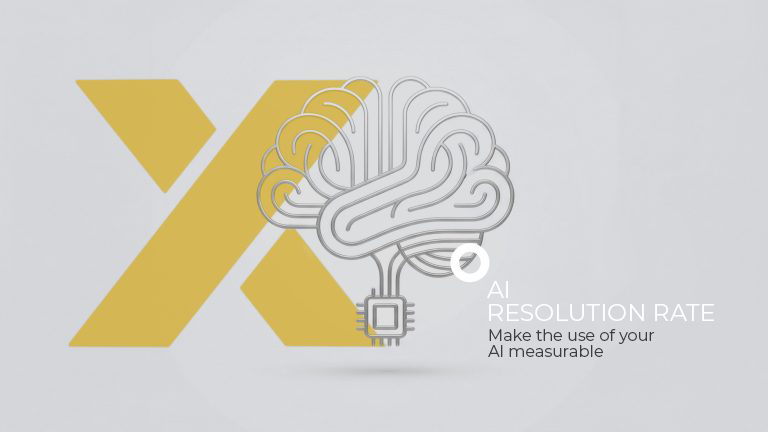
The AI Resolution Rate shows how many customer enquiries are fully resolved by AI without requiring human support. It provides a clear indication of how effectively automated customer service solutions can handle and resolve customer requests independently.
AI Resolution Rate = (Number of enquiries resolved by AI ÷ Total number of enquiries handled by AI) × 100
The key difference between the Bot Resolution Rate and the broader AI Resolution Rate lies in the scope of the systems being measured:
- Bot Resolution Rate typically refers to the performance of traditional chatbots.
- AI Resolution Rate has a broader scope and covers all AI-powered solutions, including virtual assistants and LLM-based systems.
In essence, both metrics serve the same purpose: to quantify the contribution of AI to resolving customer service enquiries.
Why Is This Metric So Important?
In digital service environments, the quality of the first interaction plays a crucial role in both customer satisfaction and support efficiency. The AI Resolution Rate indicates whether the AI solution in use is actually delivering measurable value.
- Increased efficiency and cost savings
A high rate of automated resolutions reduces the number of routine enquiries that need to be handled by human support agents. This helps lower support costs while allowing the team to focus on more complex cases. - Improved Customer Experience
When customer enquiries are resolved quickly and reliably, customer satisfaction increases. Instead of facing long waiting times, customers receive immediate answers to their questions. This creates a significant competitive advantage in today’s digital service environment. - Measurable Quality, Not Just Activity
Unlike basic activity metrics, such as the number of messages answered or the containment rate, the resolution rate measures whether the customer’s issue was actually resolved. The containment rate only shows how often a chatbot keeps a conversation within the automated channel.
How can the resolution rate be improved?
A high AI resolution rate is not based solely on smart technology; it requires continuous optimisation and strategic monitoring. The following factors play a key role in driving improvement:
- Quality and currency of the knowledge base: AI systems need access to accurate, relevant, and up-to-date information in order to understand customer enquiries and provide appropriate responses.
- Strong NLP capabilities: Advanced natural language processing enables AI systems to better understand different phrasings, contexts, and customer intents.
- Ongoing training based on real-world enquiries: Analysing past customer interactions helps identify gaps and continuously refine training data and AI performance.
- User-centred AI design: Intuitive conversation flows and clearly defined escalation paths to human agents improve both efficiency and the overall customer experience.
Relationship to other KPIs
The AI Resolution Rate should always be considered alongside other key performance indicators to provide a more complete picture of overall service quality. The following table highlights several relevant KPIs:
| KPI | Meaning |
|---|---|
| Containment Rate | The percentage of customer interactions handled entirely by the bot without human intervention, relative to the total number of incoming enquiries. |
| Customer Satisfaction (CSAT) | Customer satisfaction after a service interaction. |
| First Contact Resolution (FCR) | The percentage of enquiries fully resolved during the first interaction, across both human and AI-powered support channels. |
| Fallback Rate | The percentage of enquiries that the bot is unable to understand or answer successfully. |
In addition to the AI Resolution Rate, companies should consider other key performance indicators, such as CSAT, fallback rate, and average handling time, to gain a comprehensive view of overall service quality. The AI Resolution Rate serves as an important link between operational efficiency and customer satisfaction.
Use Case: AI-Powered Customer Service in the Electric Vehicle Industry
Electric mobility is a sector in which customer service presents unique challenges. Electric vehicle users expect not only reliable products and services, but also fast and effective support in situations that can be particularly time-sensitive, such as charging while on the road or resolving technical issues.
Typical customer service enquiries in electric mobility include:
- Charging issues at public or private charging stations
- Questions about driving range, charging times, or battery capacity
- Contract and billing enquiries related to charging providers
- Technical error messages in apps or vehicle software
Many of these issues are recurring, clearly structured, and time-sensitive. These characteristics make them particularly well suited to AI-powered customer service.
For example, an AI-powered chatbot can check the availability of a charging station in real time, explain common error codes, or guide users step by step through a troubleshooting process. If the issue is resolved entirely by the AI without human intervention, it contributes directly to the AI Resolution Rate.
This metric is particularly relevant in electric mobility. A high AI Resolution Rate shows that customers receive fast, reliable support without relying on human agents. At the same time, automation reduces the workload for support teams, allowing them to focus on more complex or safety-related second-level cases.
Companies in the e-mobility sector can also use the AI Resolution Rate to identify which service processes are already effectively automated and where human assistance is still required. This makes the KPI a valuable management tool for improving both service quality and customer satisfaction.
Measurable Value from AI in Customer Service with XELEO
The Bot Resolution Rate is a key KPI for measuring the effectiveness of AI in customer service. Particularly in dynamic sectors such as electric mobility, it provides valuable insight into how successfully automated systems resolve real customer issues without human intervention.
Companies that actively monitor and optimise this KPI can improve service efficiency and customer experience. It also provides a strong foundation for scalable, customer-focused support in an increasingly digital service landscape.
At XELEO, we are your Customer Solution Experts. Drawing on many years of industry experience, we understand what effective customer service requires. Benefit from tailored communication solutions from a single source and take your customer service to the next level.
Get in touch with us via our contact form or call us on +43 2742/28520. We look forward to supporting your next customer service project.