Onshore versus nearshore outsourcing in customer support

Outsourcing customer service is an effective way of providing customers with first-class service at all times whilst still making efficient use of internal company resources. The location of your external service provider influences various factors, such as costs, response times, compliance and, last but not least, the customer experience.
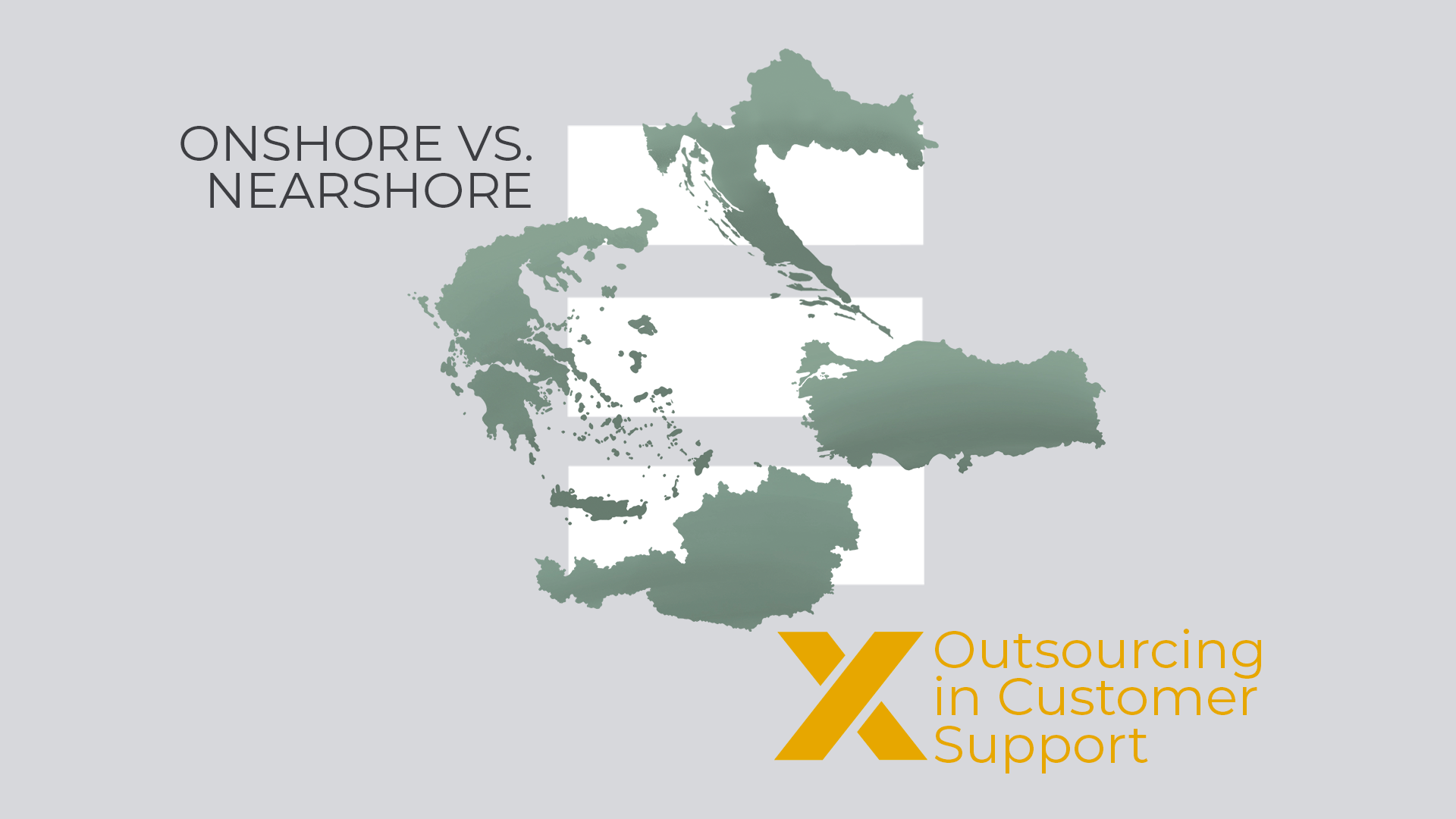
Anyone expecting an excellent standard of service in the DACH region is often faced with the question: onshore (in the same country) or nearshore (in a neighbouring country)? XELEO covers both models with staff in Austria, Greece, Croatia and Turkey, combining quality and cost benefits through an integrated approach.
Quick overview: Onshore vs. Nearshore
|
Criterion |
Onshore (e.g. Austria) |
Nearshore (e.g. Turkey/Greece) |
Hybrid (XELEO model) |
|---|---|---|---|
|
Culture & Language |
Native-speaking agents |
High cultural affinity, German/English-speaking specialists |
Combines both |
|
Time zone |
100% overlap |
±1 hour compared to the DACH region |
24/7 coverage through a mix |
|
Data protection (GDPR) |
Locally compliant |
Alignment |
Standardised security policies |
|
Scalability |
Often limited by a restricted workforce |
Large labour market, faster scaling possible |
Scaling as required |
|
Use cases |
High-empathy calls, premium brands |
Volume peaks, multilingual |
Support across various sectors and issues |
XELEO has deliberately opted for a hybrid model in order to combine cost benefits with the highest standard of service.
Onshore customer support in Austria
Those who support customers directly from Austria benefit from maximum linguistic and cultural proximity. Staff are familiar with and understand dialects, linguistic nuances and country-specific customs. Thanks to this geographical proximity, it is also easier to plan and run training sessions or workshops on site. Data protection regulations are well understood, and GDPR-compliant processes are standard practice.
However, this is offset by higher wage and office costs, which are further exacerbated by the tighter labour market for skilled workers.
This is what onshoring looks like at XELEO: the St. Pölten site serves as the operational heart of XELEO. Experienced trainers, quality teams and lead managers handle complex issues and define training standards for all sites and partners.
Nearshoring customer support in South-Eastern Europe
Nearshoring in South-Eastern Europe can significantly reduce outsourcing costs. The minimal time difference of no more than one hour still allows for live coordination. Furthermore, the market offers a large pool of multilingual agents, creating additional scope for scaling.
Typical challenges, particularly at the outset, include brand and tone training, as well as the harmonisation of quality and security standards.
XELEO organises nearshore operations as follows:
- Turkey: high-performing home-office teams, focused on specialised support
- Greece: focus on the energy sector and technical enquiries
- Croatia: home-based teams, offering high flexibility for fast response times
Furthermore, XELEO uses standardised KPI reports, quality and data protection policies across all nearshore locations. This enables us to guarantee first-class service.
XELEO’s hybrid model – onshore and nearshore go hand in hand
The hybrid set-up combines the strengths of both worlds: critical processes and sensitive data are processed in Austria, where linguistic and cultural accuracy, as well as the highest data protection standards, are guaranteed. At the same time, cost-effective nearshore teams handle high-volume first-level support, cover seasonal peaks and ensure multilingual support and 24/7 availability. This means you benefit from:
- Maximum flexibility. Rapid scaling and responses to changes in call volumes.
- An optimal cost-benefit ratio. The combination of both models enables efficient use of resources.
- Consistent quality assurance. XELEO uses standardised KPI frameworks and security standards across all locations.
Decision matrix: Find the optimal service model
Use the checklist below to assess which model – onshore, nearshore or hybrid – best meets your requirements. Simply tick the boxes wherever the statement applies to your company. Then analyse the results.
You do not need to submit the form – you can also use it for internal analysis. You will find brief instructions on how to do this directly below.
Once you have submitted the form, experts from XELEO will contact you personally.
Analysis & Recommendation
- Do your priorities lie more with ‘cost pressure’ and/or ‘seasonal peaks’?
A nearshore or hybrid model usually offers the best value for money. You reduce fixed costs and can flexibly scale capacity up or down. - Is the focus on complex specialist topics or extremely sensitive data?
An onshore set-up in Austria ensures maximum linguistic, cultural and compliance adherence. A hybrid solution with onshore escalation may also be suitable. - Do you require 24/7 availability and multilingual support?
Consider a nearshore network in South-East Europe or a combination of onshore and nearshore solutions to combine the benefits of different time zones with cost savings.
Your next step: let’s discuss your support success
Do you want to reduce service costs, manage peak workloads with ease and, at the same time, delight your customers with a measurably better experience? Then take advantage of the benefits of a hybrid model that intelligently combines onshore and nearshore services. Please feel free to contact us at any time on 02742/28520 or via our contact form.
We look forward to hearing from you!