Outsourcing in Customer Service: The Complete Guide

Customers expect prompt and expert assistance, often around the clock. At the same time, ticket volumes are rising steadily, in-house staff are becoming overburdened, and it is difficult to find new, qualified staff quickly.
Outsourcing can be the solution here: companies gain access to well-coordinated teams, tried-and-tested processes and multilingual support – quickly, flexibly and efficiently.
This guide takes you step by step through definitions, models, costs, choosing a partner and industry use cases. This will enable you to assess straight away whether outsourcing is the right choice for you.
What does customer service do?
Customer service ensures that customers are looked after throughout the entire customer journey. This begins even before the purchase, with the first enquiry about a product or a consultation, and does not end after the purchase.
Customer service answers questions, resolves problems, takes orders, deals with complaints, documents enquiries in the CRM and carries out numerous other tasks.
However, especially when dealing with growing contact volumes, seasonal peaks, extended service hours or multiple communication channels, in-house teams can quickly reach their limits. In such cases, it may make sense to outsource parts of customer service, or even the entire customer service operation, to a specialist service provider such as XELEO.
What is customer service outsourcing?
Customer service outsourcing refers to the transfer of clearly defined service processes to an external service provider. The spectrum ranges from fully managed teams (where planning, quality and reporting are entirely the responsibility of your partner) to co-sourcing or hybrid models (where internal and external teams work hand in hand).
Types of support where outsourcing can help
- Pre-sales support: Product/tariff advice, lead qualification, order assistance.
- Post-sales support: Order status, invoices, returns, complaints.
- Technical support: Fault analysis, step-by-step solutions, escalation to 2nd/3rd level where necessary.
- Complaints management: De-escalation, goodwill policies, documented solutions.
Which tasks can you outsource to a customer service provider?
- Inbound customer service: e.g. enquiries about products, contracts, orders, invoices, technical issues or general enquiries
- Telephone customer support: answering calls, advising customers, documenting information and resolving enquiries in accordance with defined processes
- Email support
- Live chat and WhatsApp support
- Order processing
- Complaints management
- Returns and complaints handling
- First-level technical support
- Emergency service and on-call support
- Customer retention
- And numerous other tasks
Channels and tools for your customer service
Modern customer service is multichannel. Customers switch between contact points and have no patience for interruptions. That is why processes and tools need a common framework: a central ticketing/CRM system, clear workflows and a consistent knowledge base.
- The telephone remains the channel of choice for urgent, complex or emotional enquiries. Customers expect to be reached, treated with empathy and provided with genuine first-time solutions.
- Email is suitable for cases that require a clear record and must be documented.
- Live chat bridges the gap between immediate assistance and asynchronous communication. It is ideal for guiding customers through the purchasing process and resolving simple issues.
- Messaging apps (e.g. WhatsApp) are particularly helpful for quick enquiries and ease of use.
Self-service is key across all channels. A well-maintained knowledge base, comprehensive FAQs and chatbots with a reliable handover to a human agent simplify the service process and make it more efficient.
Customer Service vs. Customer Support vs. Call Centre Outsourcing
You have no doubt noticed that the terms ‘customer service’, ‘customer support’ and ‘call centre outsourcing’ are often used interchangeably. In practice, however, they describe different areas of focus within customer care.
- Customer service is the overarching term and encompasses all the measures companies take to look after customers before, during and after a purchase. This includes, for example, providing advice, taking orders, handling complaints, offering technical support and dealing with general service enquiries.
- Customer support is a sub-area of customer service. The focus here is on providing specific assistance with problems, questions or technical issues.
- Call centre outsourcing primarily refers to the outsourcing of telephone-based customer communication to an external service provider. Traditional call centres handle, amongst other things, inbound calls and various hotlines. However, modern customer service set-ups such as XELEO go far beyond mere telephony and take on a variety of customer service tasks.
In short:
Customer service is the holistic approach; customer support is a specialised part of it; and call centre outsourcing is one possible model for handling customer communication externally.
When and why does outsourcing make sense in customer service?
Outsourcing is worthwhile if volumes, languages or service hours regularly exceed your internal capacity, or if you are looking for predictable growth without rigid fixed costs. Typical reasons include product launches, seasonality or internationalisation. External partners not only provide stability, but also bring best practices and lessons learnt from other projects.
Indicators that it’s time to outsource:
- Rapid growth or peaks that overwhelm recruitment processes
- Persistent waiting times and backlogs despite process optimisation
- 24/7 requirements
- Additional languages or time zones
Benefits and Opportunities of Outsourcing in Customer Service
When implemented correctly, outsourcing improves the cost structure, increases scalability and delivers more consistent quality through routine processes, training and regular reviews. However, it is also important to be aware of the risks in order to mitigate them.
|
Area |
Opportunities / Benefits |
Risks |
Countermeasures |
|
Cost structure |
Variable rather than fixed costs |
Hidden costs (licences, onboarding, QA) |
Transparent price list, monthly cost reviews |
|
Scalability |
Rapid scaling up/down |
Over- or under-staffing |
WFM playbook, weekly forecast reviews, overflow/flex shifts |
|
Quality |
Proven quality management & coaching |
Quality drift during peak volumes |
Ongoing monitoring, micro-training, keeping knowledge up to date |
|
Multilingualism |
New markets / greater accessibility |
Inconsistent tone / quality across languages |
Language training, glossary/style guide for each language, communication training |
|
Brand voice |
Professional, trained tone of voice |
Discrepancies in tone of voice |
Tone-of-voice guide with examples, ongoing monitoring and training |
|
Change management |
Internal focus on quality work |
Internal resistance |
Early communication, clear roles, internal career paths |
Different outsourcing models
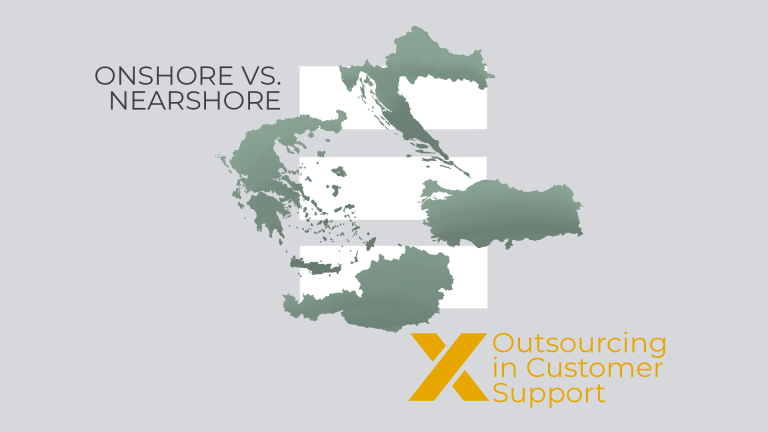
Onshore vs. nearshore
Onshore teams work in the same country or language region as your customers. This ensures maximum linguistic and cultural affinity, short decision-making processes and straightforward data protection. The cost is usually higher, and scalability may be limited by the local labour market.
Nearshore teams are based in neighbouring countries with a similar time zone. They combine cost advantages with excellent accessibility and often offer a larger pool of multilingual agents. This is ideal for high volumes, 24/7 service windows and additional languages.
A hybrid approach combines both: complex or sensitive processes are handled onshore, whilst high-volume first-level enquiries are handled nearshore.
Shared Service vs. Dedicated Team vs. Hybrid
Shared Service refers to teams that handle standardised, recurring enquiries from multiple clients, whilst a Dedicated Team works exclusively for a single brand or company. The hybrid approach therefore combines a shared service for standard tasks with a dedicated core team for brand-specific or complex issues.
Here is a brief comparison of these approaches.
|
Model |
What is it suitable for? |
Advantages |
Risks |
|
Shared Service |
Standardised, recurring enquiries with fluctuating volumes |
Cost-effective, rapid scaling/overflow |
Greater attention to tone and context required, less exclusivity |
|
Dedicated Team |
Brand-specific, more complex processes; sensitive sectors |
Maximum control & brand voice, in-depth product knowledge |
Higher costs, less flexibility |
|
Hybrid |
Mix of standard and complex processes; seasonal peaks |
Best value for money, scalable 24/7 across multiple languages |
Greater management effort required |
Costs & Pricing
An outsourcing price is more than just a rate. The full cost picture emerges during operations. In addition to the billing structure, factors such as tool licences, onboarding and shadowing, QA/training, working hours (weekends/public holidays) and project management always come into play. Understanding these components transparently from the outset helps to avoid surprises and enables realistic ROI planning.
Pricing Models
- Hourly rate: predictable working hours, high level of control for complex cases.
- Ticket/contact-based: predictability for standardised enquiries; clearly define what counts as a contact.
- Retainer/packages: bundled services (e.g. reporting, WFM, process work) at a flat rate.
XELEO offers onshore, nearshore and hybrid solutions. We recommend the most suitable setup based on your target KPIs, risk profile and channel mix. Please feel free to contact us with your specific requirements and we will put together the best model for you.
Choosing the right partner
A good start begins with clarity on objectives and KPIs (e.g. high FCR, low AHT, high CSAT), scope (channels, times, languages) and data flows. During the selection process, partners who not only promise but also demonstrate their methodologies, quality management and reporting will stand out: live demos, sample responses in your brand’s tone of voice and a realistic pilot with strict success criteria.
Selection criteria you should look out for:
- Expertise: Industry experience, e.g. telecommunications, electric mobility, …
- Languages & Staffing: WFM expertise, 24/7 capability, near-/onshore mix.
- QA & Training: ongoing training and quality control, communication training.
- Reporting: access to raw data, consistent KPI definitions.
Onboarding & Transition
- Provide documentation.
Transfer all relevant playbooks, goodwill/escalation rules and a tone-of-voice guide into a version-controlled knowledge base. Add contact/ticket logic (e.g. status, priority, tags) and a permissions framework. This ensures an optimal multichannel data flow. - Training & Development.
Combine product and process training with system exercises. This builds a solid bridge from training to practice. Short knowledge checks also help ensure quality. - Corporate Values & Communication (Do’s & Don’ts).
Show examples of both good and bad responses, typical phrasing and clarification questions. Define ‘no-gos’ (e.g. switching to informal address, making promises without confirmation) and set out the standards for empathy. Regular tone checks help stabilise the brand voice. - Test calls & fine-tuning.
Start with a pilot project or test calls. Daily stand-ups, early quality spot checks and live corrections reduce AHT and increase FCR.
Industry-specific use cases for outsourcing in customer service
Use Case 1 – Premium e-commerce (Rondoro, jewellery & engraving)
XELEO has centralised customer communications for Rondoro GmbH and harmonised service processes across all channels. Following an analysis of touchpoints, teams received targeted training. Today, the service covers personalised consultations, enquiries regarding orders and engravings, and dispatch information. The result: a consistent tone of voice, greater engagement throughout the customer journey and a noticeable reduction in the workload for internal teams.
Use Case 2 – Hybrid Onshore/Nearshore Operations (Multilingualism & Peak Periods)
With the XELEO hybrid model, complex or sensitive enquiries are handled onshore in Austria, whilst high-volume first-level tickets are processed nearshore. Standardised KPI reports, quality standards and data protection rules ensure end-to-end transparency.
XELEO – Your ideal partner for customer service outsourcing
Whether in telecommunications, energy supply, electric mobility or payments: XELEO is your partner for outsourced customer service, tailored to your sector. We combine onshore and nearshore locations into a cohesive setup: brand-specific, sensitive enquiries remain onshore, whilst high-volume standard cases are handled efficiently nearshore. This enables us to deliver availability, multilingual support and cost transparency without compromising on tone, data protection or quality.
Our strength in outsourcing lies in management and quality: version-controlled knowledge bases, regular training and transparent reporting ensure that your brand voice remains consistent and that improvements are measurable. With WFM expertise (forecasting, shift schedules, etc.), we reliably scale from seasonal peaks to 24/7 operations in multiple languages.
Through optimised processes, technical know-how and a consistently customer-focused service approach, we reduce waiting times, increase first-call resolution rates and make costs predictable. This turns outsourced customer service into a competitive advantage that builds long-term customer loyalty and noticeably reduces the workload on your in-house team.
Let us outsource your customer service and deliver a noticeable improvement. Contact us via our contact form or by telephone on 02742/28520. We look forward to speaking with you!






Frequently Asked Questions about Customer Service Outsourcing